
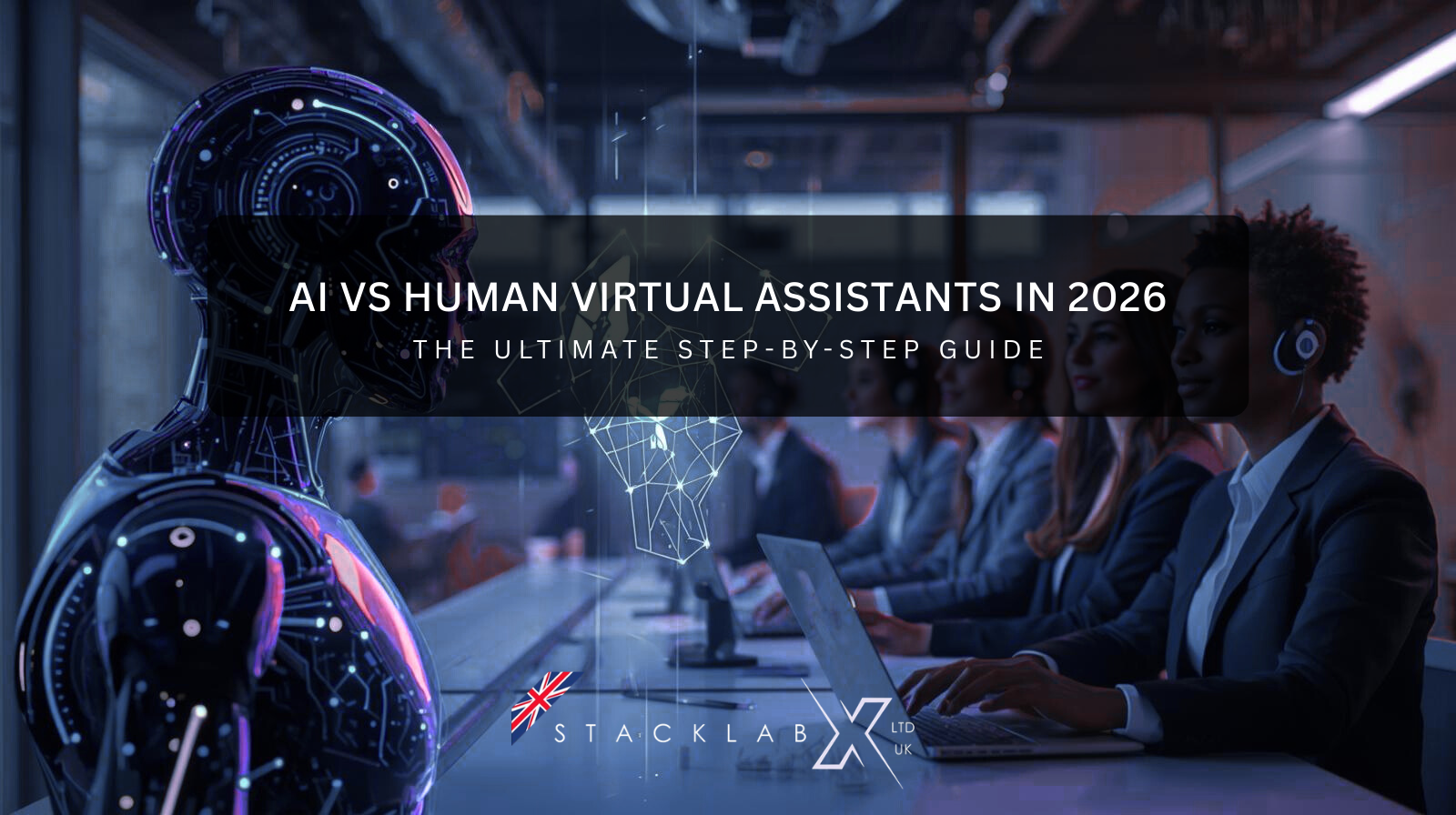
In 2026, the choice between AI vs human virtual assistants is shaping the future of work. This comprehensive guide examines their strengths, weaknesses, costs, and practical applications. From 24/7 AI efficiency to human emotional intelligence, we explore why businesses are adopting hybrid models. Learn how AI virtual assistants streamline repetitive tasks, while human VAs excel at relationship management and strategic decision-making. Whether you are a solopreneur, startup, or enterprise, understanding the differences and synergies between AI vs human virtual assistants will help you optimize productivity, reduce costs, and maintain high-quality client engagement.
The 2026 Landscape of Virtual Assistance
The digital workplace in 2026 has transformed beyond recognition. No longer are businesses satisfied with generic automation or low-cost call centers. The rise of AI vs human virtual assistants has introduced a fundamental question: should you rely on artificial intelligence that can operate at lightning speed, or invest in humans who provide judgment, nuance, and empathy?
Recent studies suggest that over 70% of high-growth companies are now using AI tools in combination with human assistants to achieve maximum productivity. This hybrid model demonstrates that AI vs human virtual assistants is not just a debate; it is a critical strategic choice affecting revenue, client satisfaction, and operational efficiency.
Businesses today are handling vast amounts of digital information—emails, CRM entries, scheduling, customer requests, and social media engagement. AI virtual assistants excel at processing and automating repetitive, rules-based tasks, whereas human virtual assistants bring creativity, decision-making, and emotional intelligence to the table. Understanding the AI vs human virtual assistants landscape in detail will help you choose the right combination for your organization.
1: AI Virtual Assistants – Speed, Efficiency, and Scale
AI virtual assistants have reached unprecedented sophistication in 2026. They are no longer simple chatbots or rule-based scripts. Modern AI virtual assistants, such as advanced implementations of ChatGPT, Claude AI, and Breeze AI, are capable of:
- 24/7 availability – Operating continuously without fatigue.
- Scalability – Handling thousands of tasks simultaneously.
- Instant data analysis – Scanning CRMs, spreadsheets, and documents to summarize, organize, or flag important items.
- Automation of repetitive workflows – Scheduling, follow-ups, and lead tracking with minimal human intervention.
Key Features of AI Virtual Assistants in 2026
- Agentic Intelligence: Modern AI can act autonomously on multiple-step workflows, e.g., receiving a client request, drafting a proposal, and scheduling a follow-up—all without human intervention.
- Predictive Task Management: AI virtual assistants analyze historical patterns to prioritize the most urgent and impactful tasks.
- Contextual Communication: AI can personalize emails or chat messages using data extracted from CRM systems, past interactions, and behavioral patterns.
- Cost Efficiency: The operational cost of AI is significantly lower than hiring human assistants. Typical usage costs range between $0.25 to $0.50 per interaction, making it ideal for businesses handling high-volume tasks.
- Data-Driven Decision Support: AI provides analytics, reports, and recommendations to help managers make evidence-based decisions.
Limitations of AI Virtual Assistants
Despite remarkable improvements, AI virtual assistants have some limitations:
- Hallucinations: Even advanced AI can provide inaccurate or misleading information if not properly supervised.
- Lack of Emotional Intelligence: AI cannot detect subtle human emotions, making it less effective for conflict resolution or sensitive client interactions.
- Limited Contextual Understanding: AI may misinterpret ambiguous instructions, such as flexible scheduling preferences or strategic priorities.
In 2026, the debate of AI vs human virtual assistants highlights that AI excels at volume, speed, and repetitive task handling, but it cannot fully replace human intuition.
2: Human Virtual Assistants – Nuance, Creativity, and Judgment
While AI virtual assistants dominate routine tasks, human virtual assistants remain essential in tasks requiring judgment, creativity, and emotional intelligence. Human VAs in 2026 are not just administrative support; they are strategic partners who augment AI capabilities.
Core Strengths of Human Virtual Assistants
- Emotional Intelligence (EQ): Humans can detect frustration, enthusiasm, or confusion in client interactions and adjust the response accordingly.
- Complex Problem Solving: Human VAs can identify systemic issues, suggest process improvements, and handle exceptions that AI might overlook.
- Relationship Management: Humans build trust with clients, stakeholders, and partners through personal engagement—something AI cannot replicate fully.
- Flexibility and Adaptability: Humans can switch between different tasks and priorities intuitively, handling ambiguous instructions with judgment.
Challenges with Human Virtual Assistants
- Higher Costs: Typical human VA rates range from $10–$25 per hour, making scaling more expensive.
- Linear Scaling: Doubling output requires hiring additional VAs, unlike AI, which scales virtually without extra headcount.
- Training and Onboarding: Humans require orientation, continuous feedback, and integration into company culture, which consumes time and resources.
Human VAs remain indispensable for high-stakes tasks, strategic thinking, and client-facing roles where mistakes can cost reputation or revenue. The discussion of AI vs human virtual assistants emphasizes that while AI offers efficiency, humans provide nuance and accountability.
3: Direct Comparison – AI vs Human Virtual Assistants
To clearly understand the strengths and weaknesses of AI vs human virtual assistants, consider the following detailed comparison:
| Feature | AI Virtual Assistant | Human Virtual Assistant | Notes |
|---|---|---|---|
| Availability | 24/7, instant | Shift-based, limited hours | AI always ready for urgent tasks |
| Cost | Low, subscription/usage-based | High, hourly/salary | AI cheaper for repetitive tasks |
| Scalability | Near infinite | Linear | AI handles volume spikes easily |
| Decision-Making | Pattern & data-based | Contextual & intuitive | Humans excel in ambiguity |
| Emotional Intelligence | Limited | High | Important for client relationships |
| Learning Curve | Instant via configuration | Days/Weeks | AI requires minimal training |
| Error Handling | Follows logic, may hallucinate | Creative problem-solving | Humans can prevent systemic mistakes |
| Relationship Building | Transactional | Relational | Humans maintain long-term trust |
This comparison highlights that the debate of AI vs human virtual assistants is not about superiority but about appropriate task allocation.
Section 4: Hybrid Models – The 2026 Best Practice
The most forward-thinking companies in 2026 are adopting hybrid virtual assistant models, leveraging the strengths of both AI and humans. This approach maximizes efficiency while preserving human judgment where it matters most.
How Hybrid Models Work
- AI as First Line: AI virtual assistants handle data entry, scheduling, CRM updates, and repetitive outreach.
- Human Oversight: Human VAs review AI-generated content, handle escalations, and manage client relationships.
- Feedback Loops: Humans train AI systems by correcting errors and improving responses over time.
Benefits of the Hybrid Approach
- Operational Efficiency: Routine tasks are automated, freeing humans for high-value work.
- Error Reduction: AI handles predictable tasks while humans handle exceptions.
- Scalable Growth: Organizations can handle more clients or leads without proportionally increasing headcount.
- Enhanced Client Experience: Humans maintain the relational and emotional touch while AI ensures speed and accuracy.
Recent surveys indicate that companies using hybrid models report up to 40% higher productivity and 30% faster response times compared to AI-only or human-only models.
Pro Tip: In the debate of AI vs human virtual assistants, assign defined, repeatable tasks to AI and complex, relational, or high-risk tasks to humans.
5: Costs and ROI Analysis of AI vs Human Virtual Assistants
Understanding the financial implications of AI vs human virtual assistants is critical for any organization. Both models offer unique benefits, but their cost structures and ROI differ substantially.
Cost Breakdown of AI Virtual Assistants
- Subscription or API Usage Fees: Many AI VAs operate on monthly or per-interaction pricing. For example, advanced platforms like ChatGPT Enterprise or Claude AI range from $50–$500/month depending on usage.
- Implementation Costs: Minimal compared to human onboarding, usually including setup, prompt engineering, and integration with existing systems.
- Scaling Costs: AI scales almost linearly with demand. Adding 1,000 additional users or tasks does not require hiring new staff.
Example: A medium-sized company using AI VAs for CRM data entry, email drafting, and scheduling may spend $1,000/month for tasks that would cost $10,000+ if handled entirely by humans.
Cost Breakdown of Human Virtual Assistants
- Hourly or Salary Costs: Human VAs typically cost $10–$25/hour globally, depending on skill level. Executive-level VAs can exceed $50/hour.
- Training & Onboarding: Initial training may take weeks, requiring oversight from managers or other team members.
- Benefits and Overhead: Health, taxes, and management add to the total cost.
ROI Comparison
| Metric | AI Virtual Assistants | Human Virtual Assistants | Notes |
|---|---|---|---|
| Initial Investment | Low | Moderate-High | AI setup is faster |
| Ongoing Cost | Predictable, low | High and variable | Depends on hours worked |
| Scalability ROI | Very High | Moderate | AI can process millions of tasks |
| Efficiency Gains | 2–5x faster | 1–2x faster | Humans excel in relational tasks |
| Error Rate | Low on repetitive tasks, risk of hallucination | Low if trained, better judgment | Humans avoid systemic errors |
| Time Savings | High | Moderate | AI works 24/7 |
From this analysis, organizations increasingly adopt hybrid models, combining AI for routine work and humans for strategic and relational tasks. The ROI of AI vs human virtual assistants is maximized when the two work together.
6: Security, Privacy, and Compliance Considerations
When evaluating AI vs human virtual assistants, security and compliance cannot be ignored. Both types of virtual assistants handle sensitive data, but their risks differ.
AI Virtual Assistants
- Data Storage Risks: AI platforms process data in cloud environments, creating potential exposure if the platform is compromised.
- HIPAA/GDPR Compliance: Enterprise AI vendors now offer compliance-ready solutions, but organizations must configure them correctly.
- Audit Trails: AI logs all interactions, which can be a double-edged sword: useful for compliance but a liability if improperly secured.
Human Virtual Assistants
- Confidentiality Risks: Humans may intentionally or accidentally leak sensitive information. NDAs mitigate but cannot eliminate risk entirely.
- Physical Security: Human VAs can be located anywhere, creating challenges in securing physical devices and work environments.
- Error Risks: Humans may mishandle data, especially under high volume or complex multi-tasking situations.
Hybrid Model Security Best Practices
The most secure implementation combines AI and humans: AI handles sensitive data processing and ensures consistency, while humans review, approve, and add context to prevent misinterpretation or errors. This balance is critical when comparing AI vs human virtual assistants in regulated industries such as healthcare, finance, or legal services.
7: Industry-Specific Use Cases for AI vs Human Virtual Assistants
Different industries leverage AI vs human virtual assistants differently. Understanding sector-specific applications helps optimize productivity.
1. Sales and Marketing
- AI: Automates lead scoring, email sequencing, and social media outreach. Tools like Breeze AI and ChatGPT Agents provide personalized messaging at scale.
- Human VA: Manages relationship-building, negotiates client contracts, and provides creative input for campaigns.
2. Customer Support
- AI: Handles FAQs, chat-based problem-solving, and ticket triaging 24/7. AI VAs reduce response times from hours to seconds.
- Human VA: Resolves escalated issues, manages VIP clients, and ensures empathy in sensitive situations.
3. Healthcare
- AI: Automates patient reminders, appointment scheduling, and preliminary medical history collection.
- Human VA: Provides telehealth support, explains treatment plans, and ensures regulatory compliance.
4. Finance
- AI: Processes transaction data, generates reports, and monitors trends for fraud detection.
- Human VA: Handles complex financial queries, ensures compliance with tax regulations, and communicates sensitive financial advice.
Across industries, the discussion of AI vs human virtual assistants demonstrates that AI dominates in structured, high-volume tasks, while humans are indispensable for high-touch, strategic, and relationship-driven work.
8: Top Tools and Platforms in 2026 for AI vs Human Virtual Assistants
Understanding the best platforms helps organizations implement AI vs human virtual assistants effectively.
AI Virtual Assistant Platforms
- ChatGPT Enterprise – Handles drafting, summarization, and API integrations for multi-step workflows.
- Claude AI by Anthropic – Offers safety-focused agentic features with minimal hallucinations.
- Breeze AI (HubSpot) – Integrated with CRM, automates prospecting and email follow-ups.
- Tact.ai – Specializes in AI-driven sales assistant workflows.
Human Virtual Assistant Services
- Belay Solutions – U.S.-based executive and administrative VAs.
- Time Etc. – Flexible human VA support for SMBs and solopreneurs.
- Magic – Global human VA network with expertise in complex tasks.
- Zirtual – Dedicated human assistants trained for productivity and project management.
Hybrid Platforms
Some services combine AI with human supervision to maximize efficiency:
- Fancy Hands – AI-assisted task triage with human completion.
- Smith.ai – Uses AI to pre-screen calls and humans to complete customer support tasks.
The key to leveraging AI vs human virtual assistants is task alignment: let AI handle repetitive, structured workflows while humans focus on high-value tasks requiring judgment, empathy, and creativity.
9: Best Practices for Implementing AI vs Human Virtual Assistants
Successfully integrating AI vs human virtual assistants requires a structured approach. Organizations that rush implementation often fail to realize the full benefits.
1. Define Clear Task Boundaries
One of the biggest mistakes in deploying AI vs human virtual assistants is task overlap. Clearly define which tasks go to AI and which go to humans:
- AI Tasks: Data entry, scheduling, FAQs, CRM updates, repetitive research, and automated notifications.
- Human Tasks: Relationship management, strategic decision-making, high-stakes client communications, and escalations.
Example: In customer support, AI can handle Tier-1 tickets, while human VAs address Tier-2 or complex customer issues.
2. Start with a Pilot Program
Before scaling, run a small pilot. Compare output, accuracy, and efficiency between AI agents and human VAs. Track metrics like:
- Task completion time
- Accuracy and error rates
- Customer satisfaction
- Cost savings
Using this pilot, companies can quantify the ROI of AI vs human virtual assistants and adjust allocations accordingly.
3. Leverage Hybrid Workflows
The future is hybrid. Use AI to generate initial outputs and humans to refine them. For example:
- AI drafts emails, and human VAs personalize them.
- AI summarizes meeting notes, and humans add strategic context.
- AI flags anomalies in CRM data, and humans verify the findings.
This combination maximizes efficiency while preserving the human touch—critical when comparing AI vs human virtual assistants in client-facing roles.
4. Train Staff and Adjust Expectations
Human VAs should be trained to work with AI, not against it. Educate your team about AI limitations, like hallucinations or context gaps, and ensure humans supervise AI when necessary.
- Example: Use AI to generate meeting agendas, but humans review them to ensure context and relevance.
5. Monitor, Measure, and Iterate
Regularly assess performance using KPIs:
- Accuracy rate of AI outputs vs human outputs
- Average response time
- Customer satisfaction scores
- Cost per task
Continuous monitoring allows you to optimize the balance of AI vs human virtual assistants over time.
10: Future Trends in AI vs Human Virtual Assistants
By 2026 and beyond, the landscape of AI vs human virtual assistants will continue evolving rapidly. Key trends include:
1. Agentic AI Dominance
AI assistants will no longer just respond—they will initiate. Agentic AI can:
- Schedule meetings automatically
- Draft contracts for review
- Execute multi-step workflows across software platforms
This increases the value of AI vs human virtual assistants, as AI handles high-volume, low-risk work autonomously.
2. Emotional Intelligence in AI
AI is increasingly capable of recognizing tone, sentiment, and context. Tools like Claude AI or next-gen Breeze AI can detect customer frustration and adapt responses, narrowing the gap between AI vs human virtual assistants.
3. Global Hybrid Teams
Businesses are creating global teams combining AI and human VAs for 24/7 operations. AI ensures speed and scale, while human VAs provide cultural understanding, judgment, and empathy.
4. Task Specialization
AI will dominate structured tasks, while humans will focus on relational, high-value, and judgment-heavy work. Organizations that clearly segment tasks will outperform competitors.
5. Ethical AI Management
As AI becomes more autonomous, ethical considerations will grow. Ensuring transparency, fairness, and privacy will be a critical part of choosing between AI vs human virtual assistants.
11: Case Studies: Real-World Applications of AI vs Human Virtual Assistants
1. E-Commerce Company
- AI Role: Chatbots handle 70% of customer inquiries, process returns, and track orders.
- Human VA Role: Escalated issues, high-value client interactions, and personalized recommendations.
- Outcome: 50% cost savings in customer support, 35% faster response times.
2. SaaS Company
- AI Role: Drafts sales outreach emails, tracks CRM updates, and schedules follow-ups.
- Human VA Role: Negotiates contracts, strategizes account management, and customizes client proposals.
- Outcome: 25% increase in deal closure rate, 40% reduction in repetitive administrative tasks.
3. Global Consultancy
- AI Role: Processes massive data reports, summarizes meeting minutes, generates dashboards.
- Human VA Role: Provides client insights, prepares presentations, and ensures regulatory compliance.
- Outcome: Enhanced productivity, reduced human error, and improved client satisfaction.
These case studies demonstrate the real power of combining AI vs human virtual assistants to maximize efficiency and effectiveness.
12: Conclusion: AI vs Human Virtual Assistants in 2026
The debate of AI vs human virtual assistants is no longer a zero-sum game. Both bring unique strengths:
- AI excels in scalability, speed, cost-efficiency, and repetitive tasks.
- Human VAs excel in judgment, emotional intelligence, relationship-building, and handling ambiguity.
The future lies in hybrid models that combine AI for routine work and humans for strategic, relational, and high-stakes tasks. Organizations that master this balance will enjoy superior operational efficiency, cost savings, and customer satisfaction.
Key Takeaway: Treat AI as the engine and humans as the steering wheel. The synergy between AI vs human virtual assistants is the ultimate formula for success in 2026 and beyond.
Read more: 👉 Best CRM with AI features in 2026
Read more: 👉 Best AI tools for sales teams in 2026
FAQs: AI vs Human Virtual Assistants
Can AI fully replace human virtual assistants?
Not yet. While AI can handle repetitive and structured tasks, humans remain essential for judgment, strategy, and relational work.
Are AI virtual assistants cost-effective compared to humans?
Yes, AI offers lower cost per interaction, scales easily, and operates 24/7. However, human oversight is still needed for quality assurance.
What industries benefit most from AI vs human virtual assistants?
Customer support, sales, healthcare, finance, and e-commerce all benefit from hybrid models that combine AI speed with human judgment.
How do I decide which tasks to assign to AI vs human virtual assistants?
Use AI for repetitive, predictable, low-risk tasks, and humans for ambiguous, strategic, or high-touch tasks.
Will AI replace human VAs in the next 5 years?
AI will continue to take over structured tasks, but humans will remain vital for high-stakes decisions, empathy-driven roles, and nuanced judgment.
What is the ROI of combining AI and human VAs?
Businesses report up to 35% efficiency gains and 90% cost reduction in routine tasks while maintaining quality for complex operations.
Can AI virtual assistants understand cultural nuances like humans?
AI is improving in sentiment analysis and context recognition, but humans are still better at nuanced, culturally-aware communication.